One Status Page Aggregator for All Your Status Pages
Your vendors are spread across dozens of status pages. IncidentHub brings them all into one unified dashboard. See every incident, update, and resolution in real time.
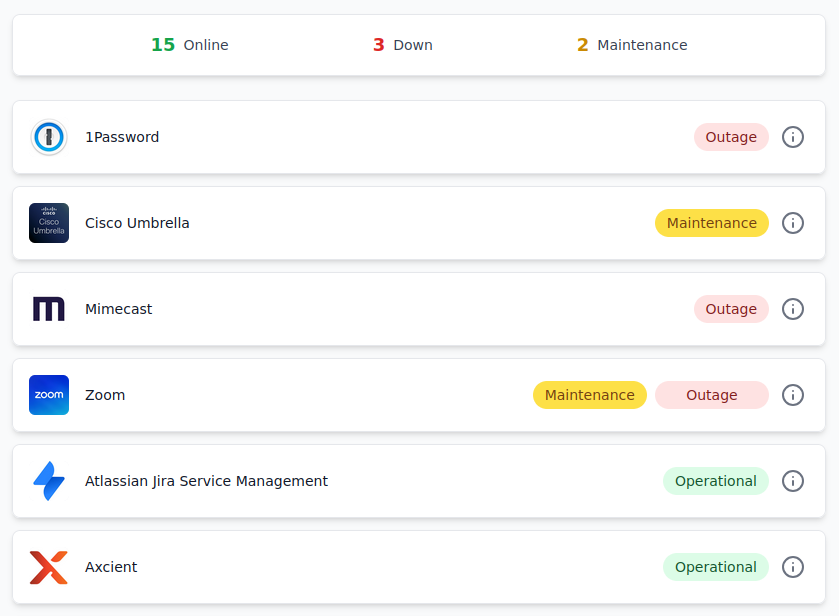
Vendor Status Pages - The Scattered Visibility Problem
Modern businesses depend on 100+ external services. Slack, AWS, GitHub, Stripe, Vercel, MongoDB, Twilio - each with their own status page. Each with their own notification system. Or no notifications at all.
Manual Checking Wastes Time
Your team manually checks 10-20 status pages every morning. "Is Stripe down?" "Is it GitHub or us?". It's easy to miss critical updates between checks. Meanwhile, incidents escalate silently. This approach does not scale as your tech stack grows.
Notification Chaos
Some vendors email updates, some don't. Some use webhooks, most don't. Incidents get lost in Slack noise or never reach the right team member. RSS feeds piped into Slack get overwhelming when there are no component filters and you get alerts for all services for a vendor.
Slower Incident Response
"Is it their problem or ours?" Without centralized third-party incident tracking, on-call engineers waste time correlating vendor outages with their own incidents. Not knowing if it's a third-party incident or an internal incident increases your MTTD and thus your MTTR.
No Context for Customers
When services are down, you can't quickly tell customers what's actually broken. "Is it us? Is it Stripe? Both?" Customer tickets pile up as support teams try to figure out what's going on.
IncidentHub: Unified Status Aggregation
Instead of checking 100 status pages, get one unified dashboard. Every vendor incident, every update, every resolution - automatically collected and correlated in one place. Fine-tuned to show only the specific services you care about in each vendor.
One Status Page for All Your Vendors
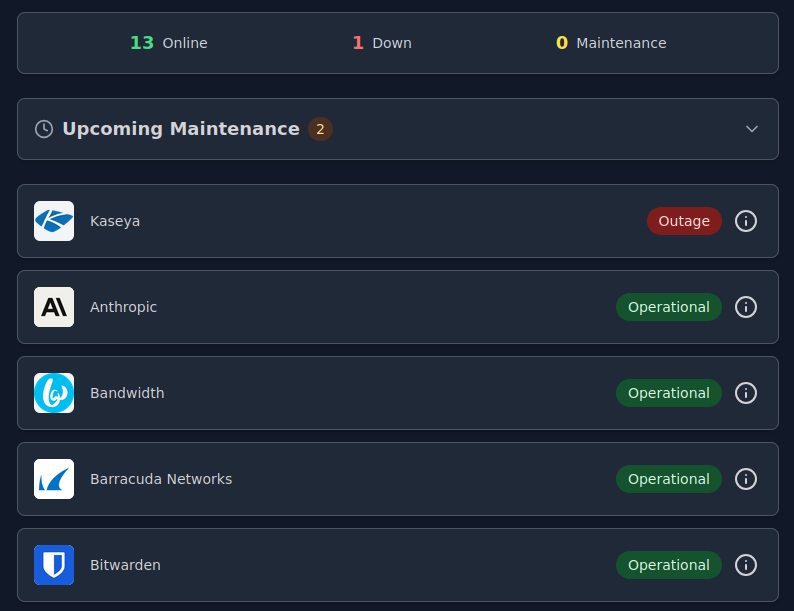
Smart Alerts
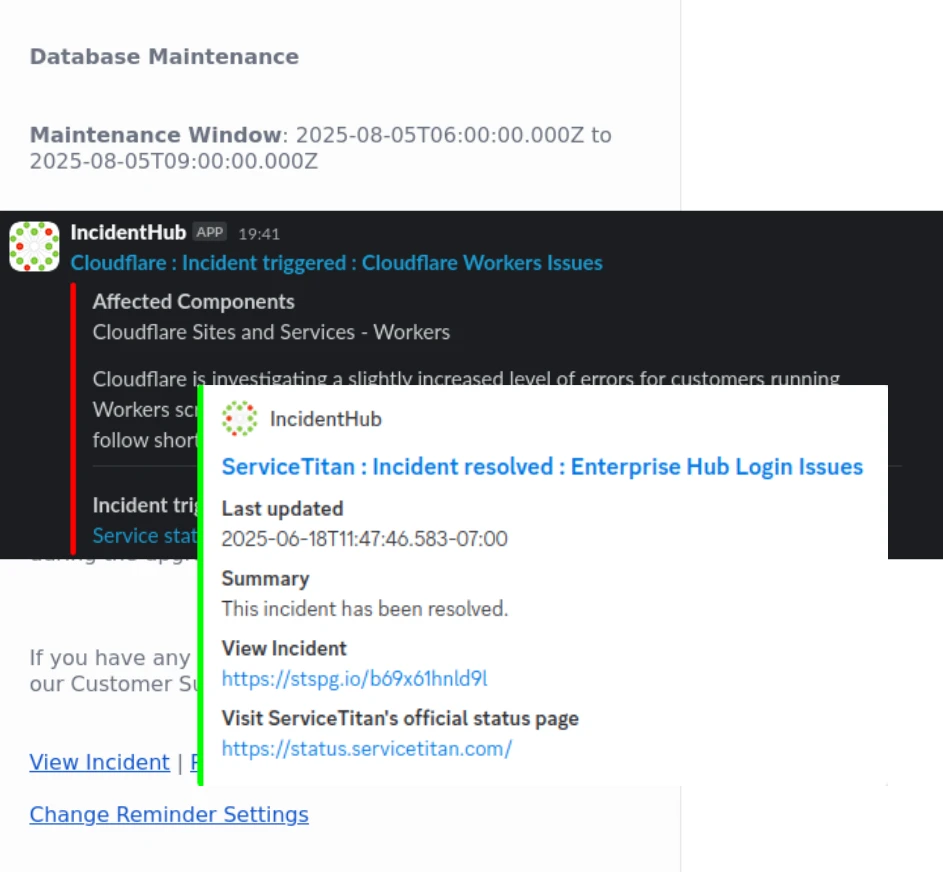
Integrates With Your Existing Workflow

IncidentHub vs Manual Checking
Read more| Capability | Manual Approach | IncidentHub |
|---|---|---|
| Unified status page | ||
| Component filtering | ||
| Auto-adjust to status page format changes | ||
| Integrate with your existing tools | ||
| View historical incident trends | ||
| Get upcoming maintenance reminders | ||
| Ingest private status page data | ||
| Turn off maintenance per service | ||
| Suppress intermediate updates per service |
1125+ Monitored Vendors
Comprehensive monitoring across all critical service categories. We add new services regularly and on request.
1125+ Global Services
Payment processors, cloud providers, SaaS platforms, dev tools, utilities, and communication services - all monitored 24/7.
Private Status Ingestion
Monitor custom vendors without public status pages. Ingest private status pages, API endpoints, or internal monitoring systems seamlessly.
Auto-Adjust to Status Page Changes
Status page formats, URLs, providers, and APIs change. We automatically adapt to these changes, preventing monitoring gaps and false alerts.
Real-Time Incident Detection
Advanced parsing extracts incident details, timelines, and resolution status automatically.
Multi-Format Support
HTML pages, JSON APIs, RSS feeds, webhooks - IncidentHub handles any status page format vendors use.
Intelligent Deduplication
One incident across multiple services in a vendor? IncidentHub recognizes related events and correlates them into single, actionable alerts.
Complete Incident History
Every incident logged with start time, duration, impact scope, and resolution timeline. Historical timeline data for compliance and analysis.
Vendor Health Scoring (coming soon)
Track vendor reliability over time. Identify risky vendors with recurring incidents. Data-driven insights for vendor selection and risk mitigation.
Community-Driven Incident Detection (coming soon)
User reports augment official status page data with early warning signals.
Track Outages for Everything
Track outages for everything your organization uses
Cloud Providers
Track infrastructure and cloud service availability
- Amazon Web Services
- Google Cloud Platform
- Microsoft Azure
- DigitalOcean
- Linode
- More...
CDN & DNS
Track content delivery and domain resolution services
- Cloudflare
- AWS CloudFront
- Fastly
- Akamai
- Cloudflare CDN
- More...
Cyber Security
Monitor your cyber security and zero trust network access stack
- Enclave
- Patch My PC
- Abnormal AI
- 1Password
- Kaseya
- Bitwarden
- More...
IT Management
Monitor your IT management tools
- Axcient
- Cisco Meraki
- Commvault
- ManageEngine
- Palo Alto Networks
- Ubiquiti
- More...
Cloud Communication and Collaboration
Monitor your cloud communication and collaboration stack
- Zoom
- LoopUp
- Docusign
- Microsoft 365
- Google Workspace
- RingCentral
- More...
Accounting and Financial Management
Monitor your accounting and financial management stack
- SAP Concur
- Planful
- Zoho Expense
- Brex
- More...
Project Management
Monitor your project management stack
- Atlassian Jira
- Asana
- Trello
- Monday
- Notion
- Basecamp
- More...
Auth And Identity Management
Monitor your auth and identity management stack
- Auth0
- Okta
- Clerk
- OneLogin
- More...
How IncidentHub Works
Data Aggregator
Pulls incident data from multiple status pages in real-time across different providers
Format Normalizer
Converts different vendor formats and schemas into one unified, standardized format
Data Sanitizer & Storage Engine
Classifies and stores incident data, sanitizes sensitive information, and stores it in a structured format
Alert Rule Engine
Applies user-specific rules and filters to incidents
Notification Delivery
Delivers incident and maintenance alerts and reminders to multiple channels
Data Source Change Detector
Continuously monitors for changes in status page formats and components